Starting and ending in Oslo
Norway in summer is hard to explain to anyone who hasn’t experienced it. The distances look manageable on a map, the roads look innocent enough, and then suddenly you’re stopping every ten minutes because the views are too good to ignore.
This trip was a classic one-week road trip, starting and ending in Oslo, heading west into the mountains and fjords. The plan was to combine camping, hiking, iconic viewpoints, and a few tourist-heavy stops that are popular for a reason.
Here’s what a week on the road in Western Norway can actually look like.
Day 1: Åndalsnes – vertical landscapes and late-night camping regrets
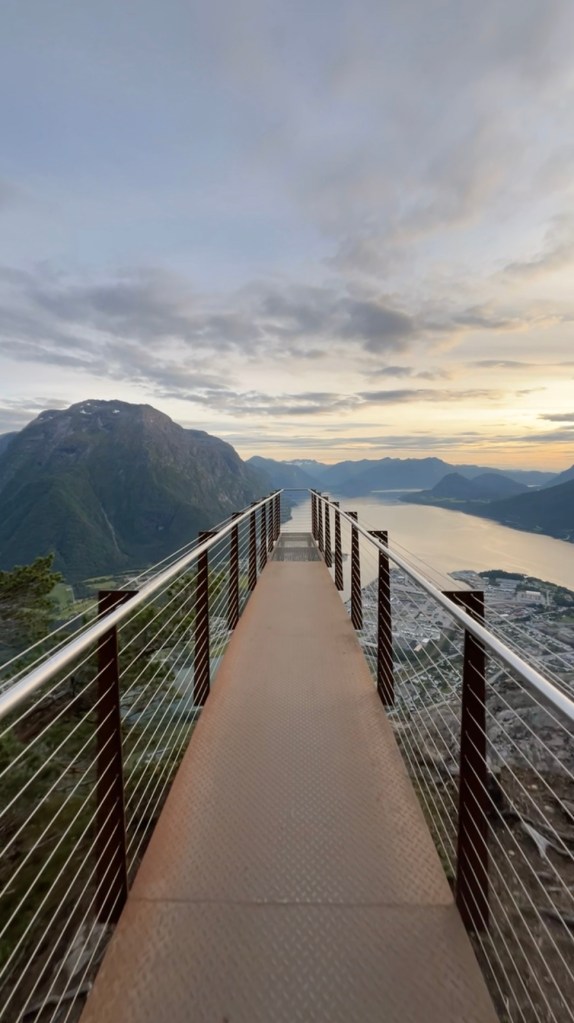
Our first major stop was Åndalsnes, and it immediately reminded us why this area is so special. Steep mountains rise straight out of the valley floor, and no matter where you look, something dramatic is happening.
The short hike to Rampestreken is absolutely worth it. Starting almost from the town center, you get a panoramic view over Åndalsnes, the fjord, and the surrounding peaks. It’s one of those hikes that gives you a huge reward for relatively little effort.
Our original idea was to camp with a tent somewhere nearby. In theory, this sounds great. In practice, we were driving around as darkness crept in (yes, even in summer it does get darker eventually), struggling to find a flat spot that wasn’t either sloped, rocky, or clearly someone’s private land. Midnight came faster than expected, and we eventually found a grass plain next to the fjord.
Big surprise, I know—who would have thought that a place dominated by mountains and fjords wouldn’t be ideal for spontaneous late-night tent pitching?
One thing that did go exactly according to plan was the drive from Dombås to Åndalsnes. This stretch is incredibly scenic and takes you past Trollveggen and Trollstigen.
Trollstigen is one of Norway’s National Tourist Routes—a curated selection of roads chosen for their natural beauty, architecture, and viewpoints. Along these routes you’ll often find designed rest stops, viewing platforms, and information boards that make the journey just as important as the destination. Even if you’re “just driving through,” it’s worth slowing down.
Day 2: Ålesund and a cold-but-perfect beach day in Giske
After Åndalsnes, we headed further west to Ålesund. Known for its Art Nouveau architecture and seaside setting, Ålesund is a nice contrast to the more raw mountain landscapes inland. It’s compact, walkable, and a good place to slow down for a few hours.
From there, we made our way to Giske for a proper beach day. The water here is unbelievably clear, with long white beaches that look almost tropical—until you step in.
Don’t be fooled. Even in July, sea temperatures usually hover around 12–14°C. Refreshing is one word for it. Brutal is another. Still, on a sunny day, it’s absolutely worth it. Few things feel more Norwegian than freezing in crystal-clear water while surrounded by dramatic coastline.
After the Åndalsnes camping disaster, we decided to be a bit more structured and stayed at Stordalen on our way to Geiranger. A wise decision.
Driving in this part of Norway is honestly unfair. Every turn reveals another fjord, another waterfall, another valley that looks like it should be on a postcard. Summer amplifies everything—the greenery, the light, the sense that you could stop anywhere and still have an incredible view.
Day 3: Geiranger overload
Geiranger is probably the most famous destination in Norway, and you’ve almost certainly heard of it. If not: it’s a small village at the end of a deep fjord, surrounded by steep mountains and massive waterfalls, including the Seven Sisters. It’s also a UNESCO World Heritage Site.
Yes, it’s busy. Yes, there are cruise ships. But it’s also genuinely breathtaking. Sometimes places are popular simply because they’re that good.
Day 4: Loen – camping perfection and a first via ferrata
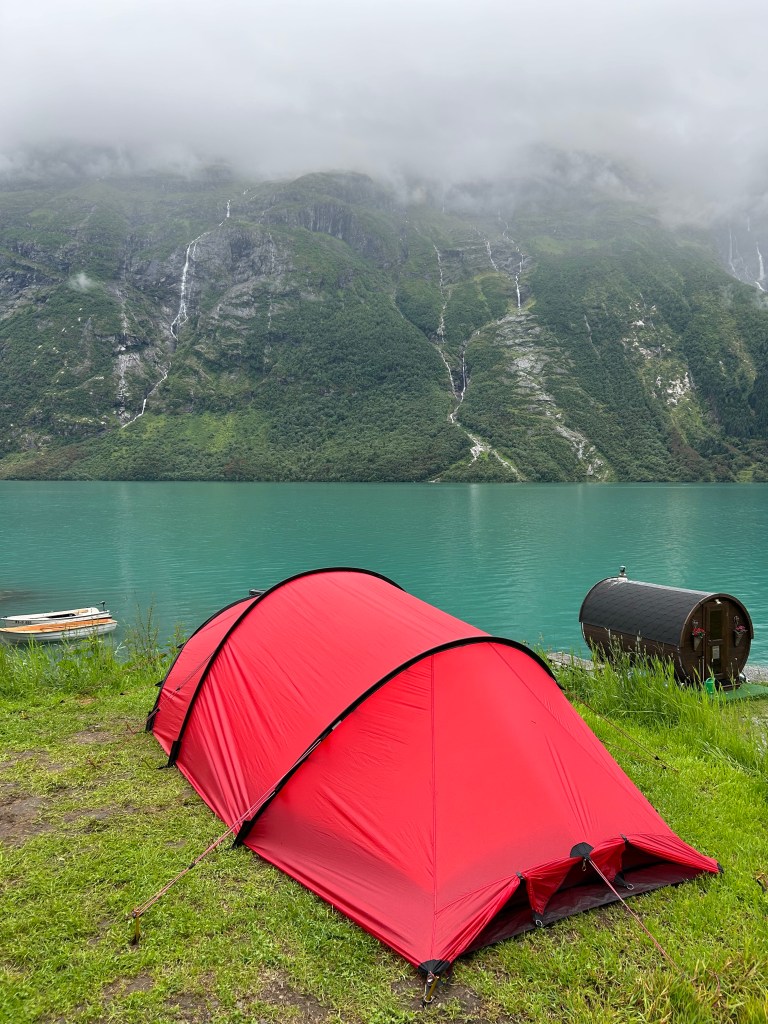
Next stop: Loen, where we stayed at Helset Camping. This has to be one of the most idyllic campings I’ve ever seen. Right by the water, surrounded by mountains, and with a sauna directly on the shore that you can book privately.
Highly recommended.
The next day, we tackled the Via Ferrata Loen—a first for all of us. Let’s just say that some enjoyed it more than others. It’s a fun and memorable experience, but you should be in decent physical shape and reasonably comfortable with heights. A few people in our group had to turn back after half an hour.
If you do go all the way up, a meal at the restaurant at the top is highly recommended before taking the Loen Skylift down. The view alone is worth it.
From Loen, we continued south and eventually made our way towards Aurland, driving the Aurlandsfjellet tourist road. This stretch is easily one of the most beautiful drives of the entire trip.
The landscape changes quickly as you climb higher, and suddenly you’re driving through snow — in July. It feels surreal. One moment you’re surrounded by green valleys, the next you’re in a high alpine environment that looks more like early spring. This road is part of Norway’s National Tourist Routes, and it’s a perfect example of why: dramatic scenery, well-designed viewpoints, and a drive that feels like an experience in itself rather than just transport.
Before heading down towards Flåm, you pass Stegastein. The platform extends out over the fjord and gives you an incredible view of Aurlandsfjorden and the surrounding mountains. It’s one of those places where photos don’t really do it justice — you just have to stand there for a while and take it in.
Day 5: Aurland and Flåm
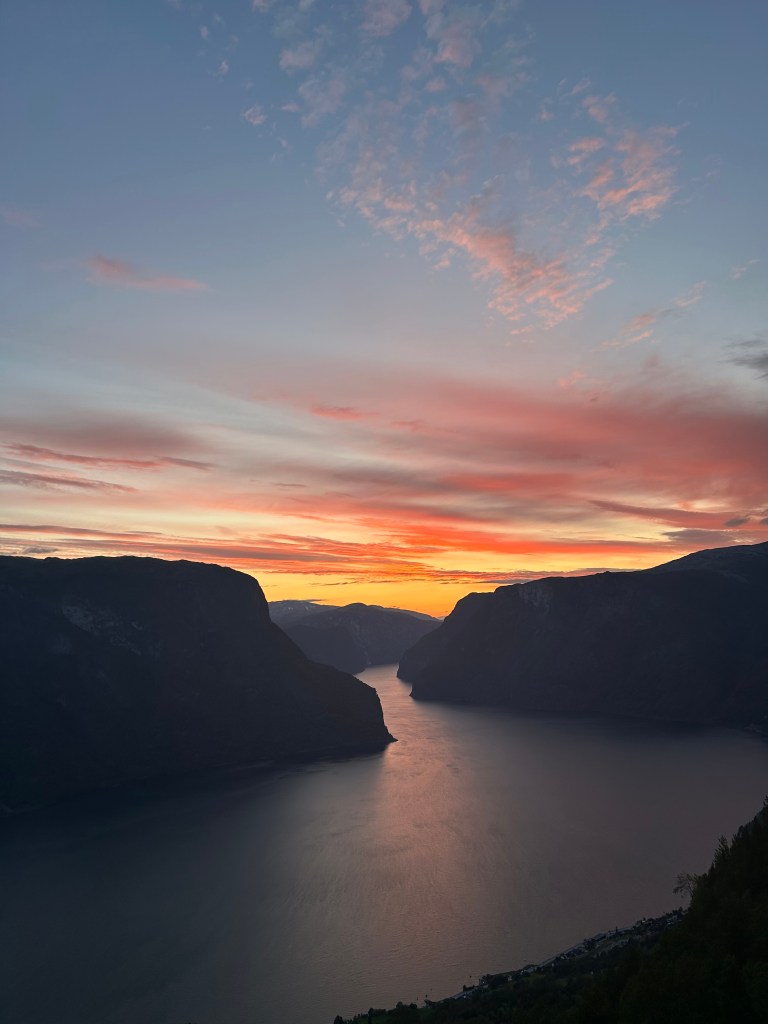
The next day was all about exploring Nærøyfjorden, often described as the most narrow fjord in the world. At its narrowest point, the fjord is only about 250 meters wide, with steep mountains rising more than 1,700 meters straight up from the water. Like Geiranger, Nærøyfjorden is also a UNESCO World Heritage Site, but it feels quieter and more intimate.
To really experience it, you can head out either by boat or kayak. Kayaking is especially popular here if you want to fully immerse yourself in the landscape — moving slowly through calm water, surrounded by towering cliffs and waterfalls, makes the scale of the fjord even more apparent.
As always in Norway, there’s no shortage of hikes nearby. Rimstigen is one of the most common in the area.
After soaking it all in, we did what we had been doing all week: got back in the car, entered Kinsarvik into the GPS, and pointed the nose south — toward the final chapter of the trip and one last classic Norwegian adventure.
Day 6-7: Kinsarvik and Trolltunga – ending with a classic
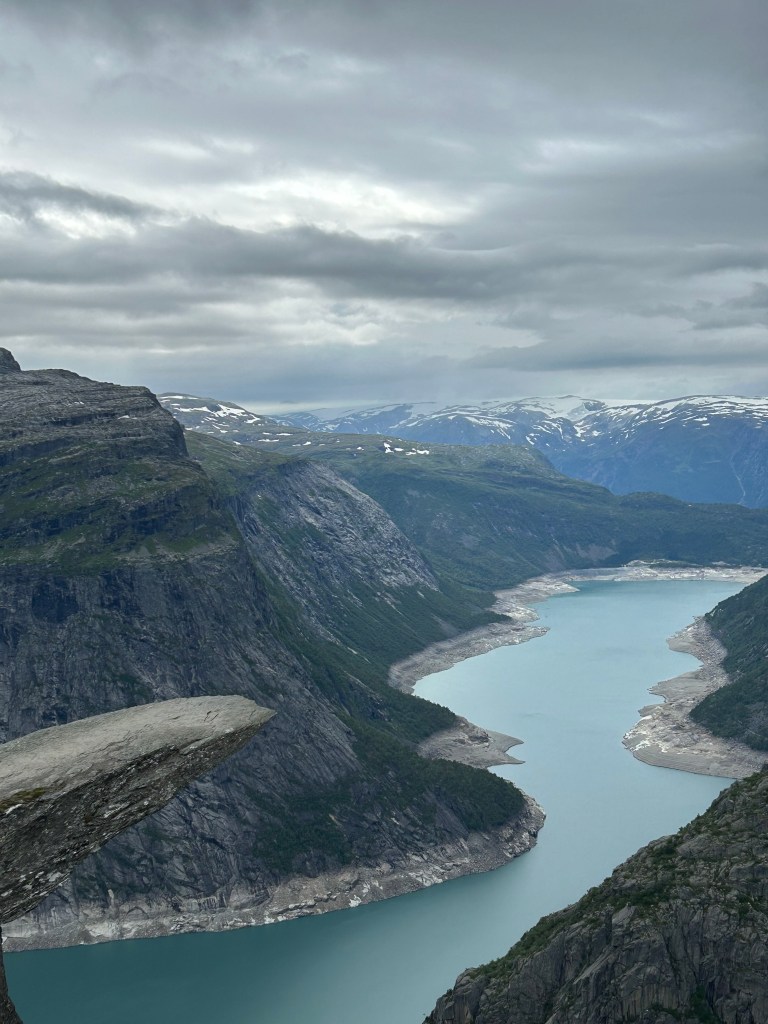
Our final stop was Kinsarvik. And yes—you guessed it—no road trip in Western Norway is complete without hiking to Trolltunga.
This is a long hike. Even if you take the shuttle bus up to the higher starting point, you’re still in for a full day on your feet. Expect changing weather, lots of elevation, and a trail that feels endless on the way back.
That said, standing on Trolltunga, overlooking the lake far below, is something you don’t forget anytime soon. It’s one of those places that lives up to the hype.
We didn’t plan quite carefully enough and missed the last bus back to the parking area. That resulted in an unplanned (and expensive) taxi ride. Learn from our mistake: double-check bus schedules and give yourself a margin.
Final thoughts
A week is enough to get a taste of Western Norway—but not enough to feel done. This trip had mountains, fjords, beaches, tourist icons, small mistakes, and moments where we just sat quietly and took it all in.
If you’re planning a similar route, my biggest advice is simple: plan the framework, but leave room for spontaneity. Norway rewards slow travel, curiosity, and the occasional wrong turn.
And maybe don’t wait until midnight to find a campsite in Åndalsnes.
 Guide Norway
Leave a comment